Hang tags that do the talking on the rail
A hang tag hangs at eye level and is often the first thing a customer touches. Before anyone reads a word, the weight of the board, the texture of the surface and the way light catches a foil have already said something about the garment and its price. Custom hang tags carry practical information too: size, price, barcode, collection name, sometimes a short brand story or a QR code. Getting the construction right means balancing all of this on a piece of card a few centimetres wide.
We help you choose a hang tag that suits your style and price level, from a single uncoated card to layered tags with a die-cut window. Everything starts with a digital proof; once you approve it, production and delivery take 10 days.
Choosing the board for your hang tags
Weight and thickness
Board is specified by weight in grams per square metre (gsm) and by thickness, known as caliper, expressed in microns or points. The two are related but not interchangeable: a bulky uncoated cotton board can be noticeably thicker than a dense coated board of the same gsm. Many retail swing tickets are printed on board of around 300–350 gsm. Heavier, more rigid tags are produced either on thicker single boards or by laminating two sheets together into a duplex board, which gives a substantial feel and allows a different colour on each face.
Board types
| Board | Surface and effect | Works well with |
|---|---|---|
| Uncoated board | Natural, tactile, absorbs ink softly | Blind embossing, letterpress-style deboss, foil |
| Coated board (matte or gloss) | Smooth, sharp detail, bright colours | Full-colour photos, spot UV, fine text |
| Cotton board | Soft, thick, slightly textured | Deep debossing, premium minimal designs |
| Coloured-through board | Colour on faces and edges alike | Foil on dark board, white or metallic print |
| Kraft or recycled board | Earthy, honest, visible fibres | Denim, casual, workwear, single-colour print |
| Duplex (laminated) board | Extra thickness, two colours | Contrast edges, luxury tags |
Where sustainability matters, we can source boards made from recycled fibre or papers from responsibly managed forests; tell us which documentation your buyers expect so we can propose suitable papers. OEKO-TEX and GRS options are available for selected materials.
Printing methods for custom hang tags
Offset printing
Offset lithography transfers ink from a plate via a rubber blanket onto the board. It needs plates and make-ready time, but once running it is fast: trade sources describe sheetfed offset presses running in the region of 10,000 to 15,000 sheets per hour. Offset gives very even solids, precise Pantone spot colours and sharp small type, which is why it is the standard for larger runs and brand colours that must stay identical season after season.
Digital printing
Digital presses, toner or inkjet, print directly from the file with no plates. Manufacturer figures for B2 sheetfed inkjet presses are in the range of several thousand sheets per hour, slower than offset but with almost no set-up. Digital is ideal for short runs, many designs in one order, and variable data such as individual prices, sizes, numbers or QR codes on each tag.
Screen printing
Screen printing lays down a thick, opaque ink film. It is the method of choice for white or light colours on dark or kraft board, and for tactile effects such as raised varnish.
Finishes: foil, embossing, spot UV and lamination
- Hot-foil stamping uses a heated metal die to transfer metallic or pigment foil: gold, silver, copper, holographic, black or white. It reads beautifully on uncoated and dark boards.
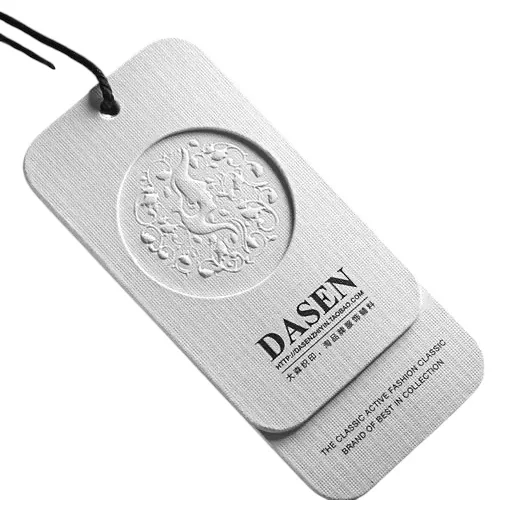
- Blind embossing and debossing press the logo up or into the board without ink, using a matched die pair. Thick cotton and uncoated boards show the deepest relief. Combining foil and embossing in one die gives a raised metallic logo.
- Spot UV is a clear varnish cured with ultraviolet light on selected areas, creating gloss against a matte background. It is usually applied over matte lamination for maximum contrast.
- Lamination adds a thin film, gloss, matte or soft-touch, that protects print from scuffing and gives a velvety hand. Note that laminated and spot-varnished tags are harder to recycle; for a fully recyclable tag, choose uncoated board with foil or embossing.
- Edge colouring paints the edges of thick or duplex tags in a contrasting colour for a refined finish.
Shapes, die-cutting, layers and pockets
After printing and finishing, the sheets are die-cut. Flatbed die-cutters press a steel-rule die through the sheet and handle thick board well; industry buyer guides put typical flatbed output at a few thousand sheets per hour, with modern high-end machines rated up to around 7,000–8,000. Rotary die-cutting with cylindrical dies is faster and suits very long runs. For hang tags, flatbed cutting is the usual route because it copes with heavy and duplex boards and allows cost-effective dies for each new shape.
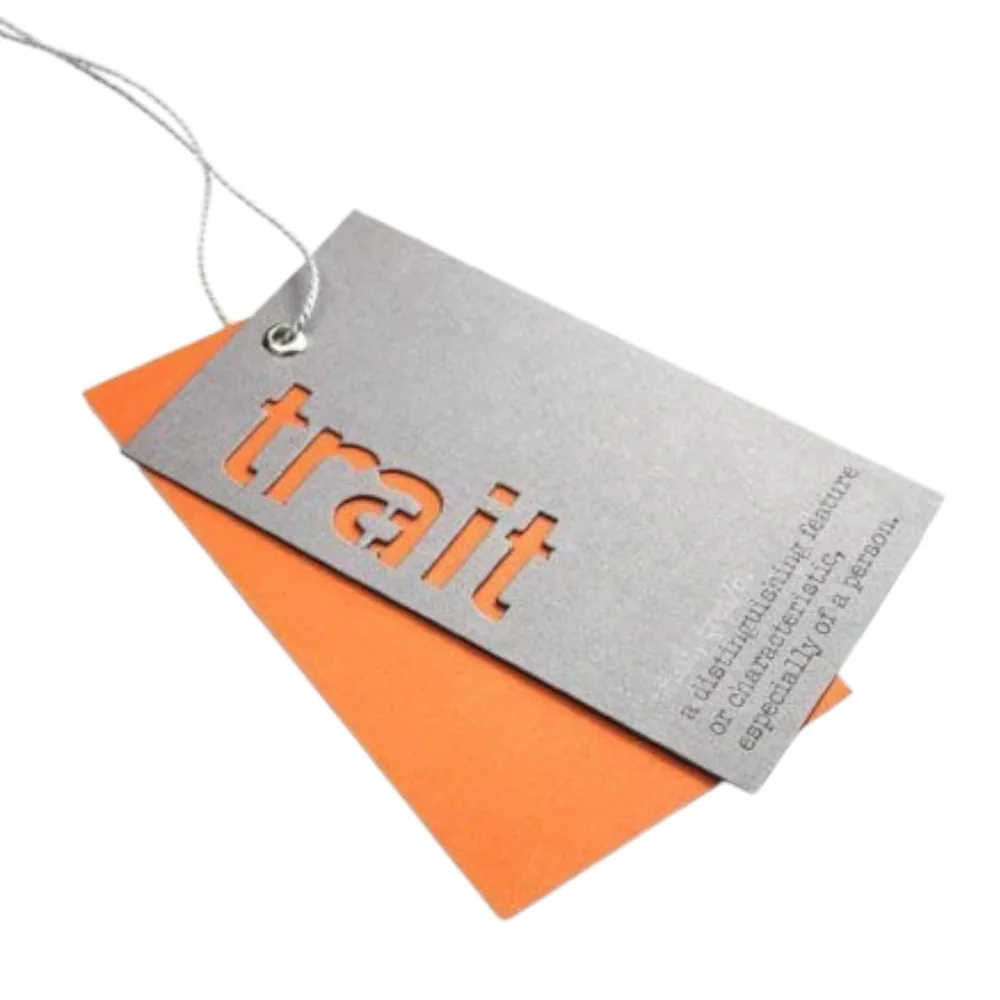
Die-cutting opens up many possibilities: rounded corners, cut-out logos, tags shaped like a monogram, two boards layered so a colour peeks through a window, or folded tags that open like a small booklet. A pocket tag can hold a spare button or a small care card. We advise on what can be produced cleanly at your size and how the pieces fit together.
Holes and eyelets
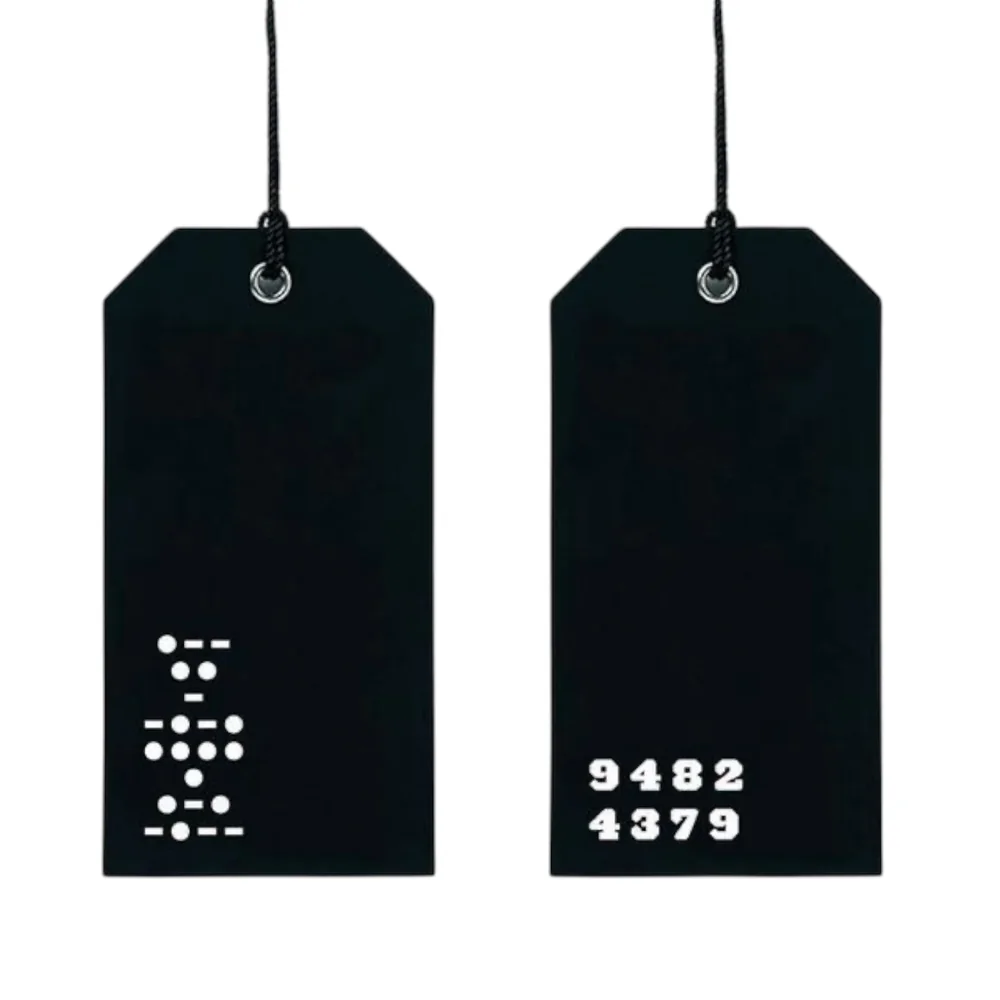
The string hole is punched during die-cutting. A metal eyelet reinforces it so heavy tags do not tear off; every eyelet we use is nickel-free. Keep the hole a comfortable distance from the edge and from any text so that the board does not crack and nothing important is covered by the string.
Strings, seals and fixings
The fixing completes the tag. Cotton, waxed or elastic cords, satin ribbons, woven tape strings, plastic or nickel-free metal seals with an embossed logo, and safety pins each create a different finish. Pre-strung tags save time when garments are tagged, and colour-matched cords make the whole set feel considered. For tagging through a fabric loop or label, plastic fasteners applied with a tagging gun are the quickest option; our label fasteners page covers them.
How hang tags are produced, step by step
- Brief. Size, board, print colours, finishes, shape, hole position and fixing are agreed.
- Digital proof. A flat proof shows the front, the back, the die line, the foil and emboss areas and the hole. You approve it before anything is made.
- Prepress and tooling. Files are imposed on the sheet; plates, foil and emboss dies and the cutting die are prepared as the design requires.
- Printing. Offset, digital or screen, front and back.
- Finishing. Lamination, spot UV, foil and embossing are applied in sequence, each registered to the print.
- Die-cutting and punching. Tags are cut to shape and holes punched; eyelets are set where specified.
- Assembly. Duplex boards are laminated, layered tags assembled and strings or seals attached.
- Quality control. Colour against the approved references, registration of foil and emboss, clean cuts and secure eyelets are checked.
- Packing. Tags are counted and banded per design and size, ready for the tagging line.
Production and delivery take 10 days from artwork approval. See our production page for how hang tags fit into a complete label order.
Common hang tag defects and how to avoid them
- Foil or emboss out of register: allow a little tolerance between foil and printed elements instead of butting them edge to edge.
- Cracking on folds: thick board must be creased before folding; tell us if a tag folds.
- White edges on dark tags: use coloured-through board or edge colouring instead of printing a dark colour on white board.
- Text too close to the cut: keep a safety margin of a few millimetres inside the die line and add bleed outside it.
- Barcodes that will not scan: keep barcodes in high contrast, at sufficient size, away from foil and textured areas.
- Tags tearing off: on heavy garments, add an eyelet or choose a thicker board.
Artwork requirements for hang tags
- Print-ready PDF or vector files, fonts outlined, front and back on separate pages.
- Bleed beyond the die line and a safety margin inside it.
- Pantone references for spot colours; CMYK images at a suitable resolution for full-colour areas.
- Foil, emboss and spot UV areas supplied as separate vector layers, each named.
- Die line for custom shapes, with the hole position marked.
- Variable data, such as prices, sizes or barcodes, supplied as a spreadsheet when it changes per tag.
Hang tag checklist
- Board and caliper chosen for the feel and the garment weight.
- Printing method suits the run and the colours.
- Finishes are compatible with the board and with your recycling goals.
- Die line, hole position and any eyelet are on the proof.
- Back of the tag has space for price and barcode.
- String or seal colour coordinated with the tag and the garment.
- Information matches the garment labels: the size printed on the tag matches the size label.
Plan hang tags with your labels
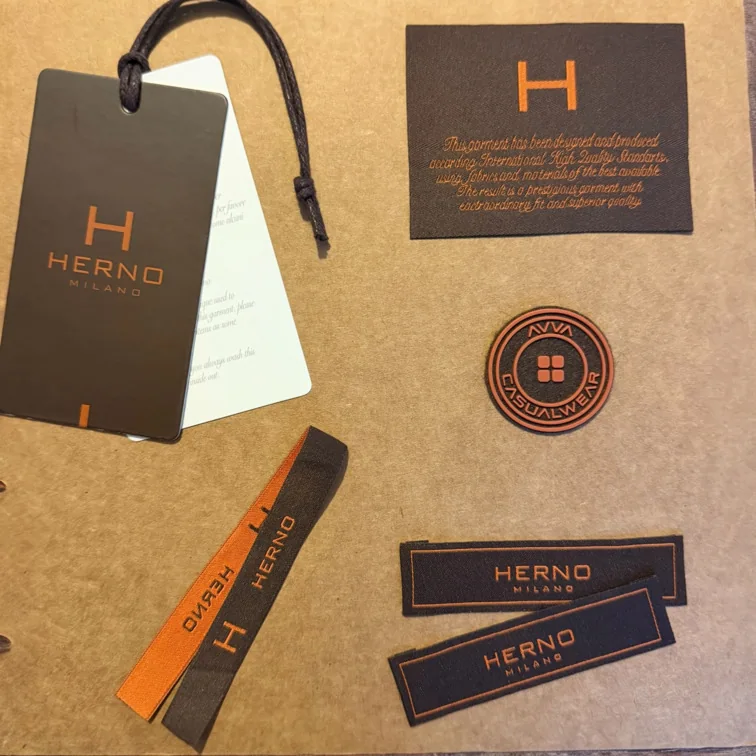
When your woven label, care label and hang tag are designed together, colours, fonts and proportions can echo each other. A tag in coloured board with a foil logo, a woven label in the same tones and a matching seal make a collection look coherent in store and in photos. Ask us to prepare the set as one proposal.
Frequently asked questions
01What board weight should we choose for hang tags?
Many retail tags use board of around 300–350 gsm. For a heavier, premium feel, a thicker cotton board or a duplex construction of two laminated boards works well. Remember that thickness also depends on the board type, not only the gsm.
02Offset or digital printing: which is better for hang tags?
Offset gives the most precise spot colours and is efficient for larger runs. Digital needs no plates and is ideal for short runs, several designs at once or variable data such as individual prices and codes.
03Can you combine foil and embossing on one tag?
Yes. A combined die can foil and emboss in one pass for a raised metallic logo, and separate foil, blind emboss and spot UV areas can sit on the same tag.
04Are the eyelets and metal seals nickel-free?
Yes. All metal parts we supply, including eyelets, seals and pins, are nickel-free.
05How long does hang tag production take?
Production and delivery take 10 days from artwork approval. The process is: price request, digital artwork proof, approval, production and delivery.
06Can hang tags be made more sustainable?
Choose uncoated recycled or kraft board, keep lamination and spot UV to a minimum, and use cotton strings. Blind embossing and debossing add impact without adding any extra material to the board.
Share your design and preferred finishes through the price request form and we will send a digital proof for approval.