What size labels do, from the cutting room to the fitting room
Size labels look like the simplest item in a trim pack, yet they are read by more people than any other label on the garment. The operator on the sewing line checks the tab before attaching it, the packer checks it before folding, the warehouse checks it before picking, and the customer checks it in the fitting room and again at home. A clear size label, or a neat size tab placed beside the brand label, makes every one of those moments faster and removes a common cause of returns: a garment that was simply labelled with the wrong size.
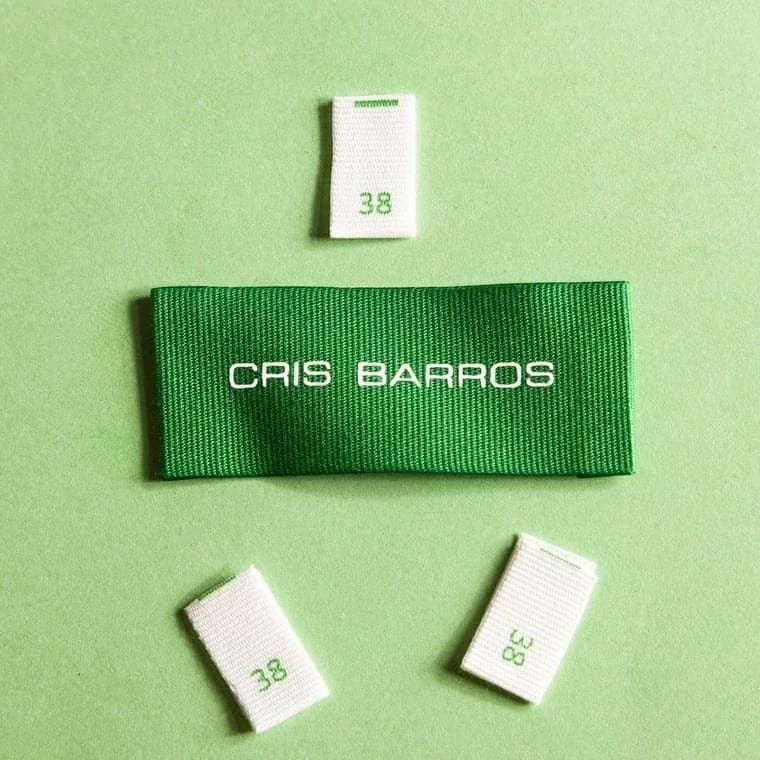
Keeping the size on its own small tab has a practical advantage too. One main label can serve the whole style, while the size changes on a separate piece that costs little and is easy to re-order. When only the extremes of the size range sell out, you replenish two or three sizes rather than a full set of main labels.
Woven or printed size labels: choosing the construction
The first decision is how the numerals are made. Both routes give a clean result, but they feel different against the body and suit different garments.
| Construction | Character | Edges | Works well for |
|---|---|---|---|
| Woven size tab | Dense, slightly raised numerals; matches a woven brand label | Heat-sealed or ultrasonic cut, or woven selvedge on narrow tape | Shirts, tailoring, knitwear, outerwear, denim |
| Printed size tab | Very thin and soft; quick to change between sizes | Cut from printed tape, sealed by heat or ultrasound | T-shirts, lingerie, swimwear, babywear |
| Size on the care label | One piece carries care, fibre and size information | As for the care tape | Basics and high-volume programmes |
| Size woven into the main label | Most discreet; no extra piece in the seam | As for the main label | Small collections with few sizes |
Woven size tabs
A woven tab is built thread by thread, so the numeral is part of the fabric and cannot rub off. Damask quality gives the finest detail, which matters on a tab that may only be 10 to 15 mm wide. Woven tabs sit naturally next to woven labels and can share the same ground colour, so the pair reads as one design.
Printed size tabs
Printed tabs are made on satin, taffeta, polyester or cotton tape. They are the softest choice and the easiest to vary, because changing a size means changing a digital file rather than a weaving programme. For close-to-skin pieces they are often the more comfortable option, and they combine well with printed labels carrying the brand name.

Size combined with other information
For high-volume basics, the size often sits on the same tape as the washing symbols and fibre content. This saves one piece per garment but means the whole tape changes with each size. If you take this route, plan the layout together with your care labels so the size sits in the same position on every version.
Size systems you can show on a size label
Letter sizes
XXS to XXXL (often written 3XL and upwards) is the most widely understood system and the easiest to read at a glance. Letters work best when the garment has some ease, such as knitwear, jersey and outerwear. Decide early how you write the larger sizes, because XXL and 2XL take different widths on a small tab.
Numeric sizes and market equivalents
Numeric sizes differ from country to country, and no conversion is exact, because each brand grades its own patterns. Brand size charts commonly place the following women’s sizes side by side; treat them as a reference row rather than a rule.
| UK | US | FR | DE | IT |
|---|---|---|---|---|
| 8 | 4 | 36 | 34 | 40 |
| 10 | 6 | 38 | 36 | 42 |
| 12 | 8 | 40 | 38 | 44 |
| 14 | 10 | 42 | 40 | 46 |
When a garment is sold in several markets, a size label can show two or three systems on one tab, for example IT 42 / FR 38 / UK 10. Keep the order identical across every size of the style and across the collection, so the eye always finds the home market in the same place. Menswear trousers are often labelled by waist and leg length in inches, while tailoring frequently uses chest-based numeric sizes; both fit comfortably on a woven tab if the type is set compactly.
EN 13402 and body-dimension labelling
The European standard EN 13402 describes size labelling based on the body rather than the garment. A pictogram shows a simplified figure with the measuring positions, and beside it the label gives the body dimensions the garment is designed for, in centimetres. Each garment type has a primary dimension, such as chest girth for a jacket or waist for trousers, and may add secondary ones such as height. Girths are typically stepped in 4 cm intervals and height in 8 cm intervals for most garments, so a label might read a chest of 100 cm and a height range of 172 to 180 cm. Body-dimension labels need more space than a single letter, so they are usually printed rather than woven, often as part of a longer tape.
Children’s sizes
Childrenswear is commonly labelled by height in centimetres (for example 92, 98, 104, 110), by age range, or by both. Height-based sizing helps parents most, because children of the same age vary widely. For babywear, choose a soft printed tab and keep it out of the neck area where possible.
Colour-coded size tabs
A different ground colour or lettering colour for each size lets staff pick and sort at a distance, without reading the numeral. It works especially well for uniforms, workwear, hosiery and multipacks. Keep the scheme simple: a short sequence of clearly distinct colours, never two similar shades on neighbouring sizes, and the same scheme every season. Colour-coded tabs are also useful inside the factory, because a wrong tab stands out immediately in a bundle of identical garments.
How size labels are produced, step by step
- Artwork and size list. We receive the label design and the complete list of sizes with quantities per size. Every size becomes its own version in the file.
- Digital proof. You approve a digital proof showing each size at real scale, with fold lines and seam allowance marked.
- Set-up. For woven tabs, the design is converted into a weaving programme; for printed tabs, the print files and tape are prepared. All sizes of one design are usually run in sequence on the same set-up.
- Weaving or printing. The tape is woven or printed in continuous lengths, with each size repeated as many times as its quantity requires.
- Cutting and folding. The tape is cut into single pieces and folded to the chosen format.
- Quality control. Numerals, colours, dimensions and counts are checked size by size.
- Packing per size. Each size is bagged or bundled separately and marked with style and size, ready for the sewing line.
Production and delivery take 10 days from artwork approval, which suits replenishment orders when a few sizes run short in the middle of a season. You can read more about how we work on the production page.
Weaving
Woven labels are made either on broad jacquard looms, where many labels are woven side by side and then slit apart, or on narrow needle looms, which weave individual tapes with a true woven edge. Published machine speeds vary widely: basic label looms are listed at around 450 to 650 rpm, while high-speed narrow-fabric needle looms are quoted by their makers at well over 2,000 rpm. Real output depends on weave density, label width and how many repeats run across the loom, so speed reflects the design as much as the machine.
Printing
Printed size labels are produced by thermal transfer or flexographic printing. Thermal transfer printers for textile tapes typically run in a range of roughly 100 to 300 mm per second, which makes them well suited to many short size versions. Flexographic printing suits long, repeating runs of the same size and colour. In both cases the ink or resin ribbon is chosen for wash and dry-cleaning resistance.
Cutting and folding
Synthetic tapes are cut with a heated blade or by ultrasound, both of which seal the edge so it does not fray. Ultrasonic cutting gives a particularly soft, smooth edge, which matters on a tab that sits against the neck. Equipment listings quote throughputs from about 100 to 250 pieces per minute, depending on label length and fold type. Folding options include flat, centre fold for a loop in the seam, end fold with both ends turned under for topstitching, and mitre fold for hanging loops.
Planning the size curve
Order size labels by the size curve of each style rather than by an even split. A typical womenswear curve concentrates quantities in the middle sizes and tapers towards both ends, and your cutting plan already contains these figures. Add a small reserve on every size for sewing losses and repairs, with a slightly larger reserve on the smallest and largest sizes, because those are the ones most often re-cut. Because each size is packed separately, the reserve stays sorted and ready for the next cut.
Placement and sewing
- Back neck: the tab sits beside or under the main label, sewn into the same seam. Centre-folded tabs are the usual choice here.
- Side seam: common for trousers, skirts and lingerie, often attached together with the care label.
- Waistband: numeric sizes and waist and leg sizes on trousers and jeans.
- Visible outside: a small size marker on the hanger loop or the outside of a pocket bag speeds up shop-floor sorting.
Allow a few millimetres of seam allowance on each sewn end, keep the numeral well clear of the stitch line, and match the width of the tab to the main label so they stack neatly.
Typical size label faults and their causes
- Mixed sizes in one bundle: avoided by packing and marking each size separately and by colour-coding where volumes are high.
- Numerals lost in the seam: avoided by marking the stitch line on the proof and leaving enough space between text and fold.
- Scratchy edges: avoided by choosing ultrasonic cutting or a soft fold so cut edges are turned inwards.
- Fading print: avoided by matching ribbon or ink to the washing and dry-cleaning conditions of the garment.
- Thin strokes breaking up in weaving: avoided by using a damask quality and keeping strokes to a weight the weave can hold.
- Inconsistent conversion rows: avoided by fixing one size table for the whole collection before artwork starts.
Artwork requirements for size labels
- Vector files, such as AI, EPS or PDF, with all lettering outlined.
- One artboard or page per size, named with the size it shows.
- Finished width and length, fold type and seam allowance stated.
- Colours specified by Pantone reference for ground and lettering.
- A stroke weight that the chosen technique can reproduce; very light typefaces are better kept for printed tabs.
Size label checklist
- Construction chosen: woven tab, printed tab or size on another label
- Size system fixed, including the order of any market equivalents
- Colour code agreed, if used
- Fold type, finished size and seam position confirmed
- Quantities per size taken from the size curve, plus reserve
- Packing and marking per size requested
- Material and print resistance matched to the care instructions; OEKO-TEX and GRS options are available for selected materials
Ready to plan a set? Share the size list and label artwork on the price request form; each size then gets its own digital proof.
Size labels: frequently asked questions
01Should the size be on a separate tab or on the main label?
A separate size tab lets one main label serve the whole style and makes re-ordering single sizes simple. Putting the size on the main label is neat for small collections with few sizes, but every size then needs its own main label.
02Woven or printed: which size tab is more durable?
Both last the life of the garment when chosen correctly. Woven numerals are part of the fabric and cannot wear off; printed tabs use wash-resistant inks or ribbons and are softer against the skin.
03Can one size label show several international sizes?
Yes. Two or three systems fit on a single tab, for example IT, FR and UK. We keep the same order on every size so customers always find their market in the same place.
04What is EN 13402 labelling?
It is a European standard that describes sizes through body dimensions in centimetres, shown next to a pictogram of the measuring positions. It needs more space than a letter size, so it is usually printed on a longer tape.
05How are size labels packed?
Each size is packed and marked separately with style and size, so labels go straight to the sewing line without sorting.
06How quickly can size tabs be replenished?
Once you approve the digital proof, size labels are produced and delivered within 10 days, so a short-running size can be topped up mid-season.