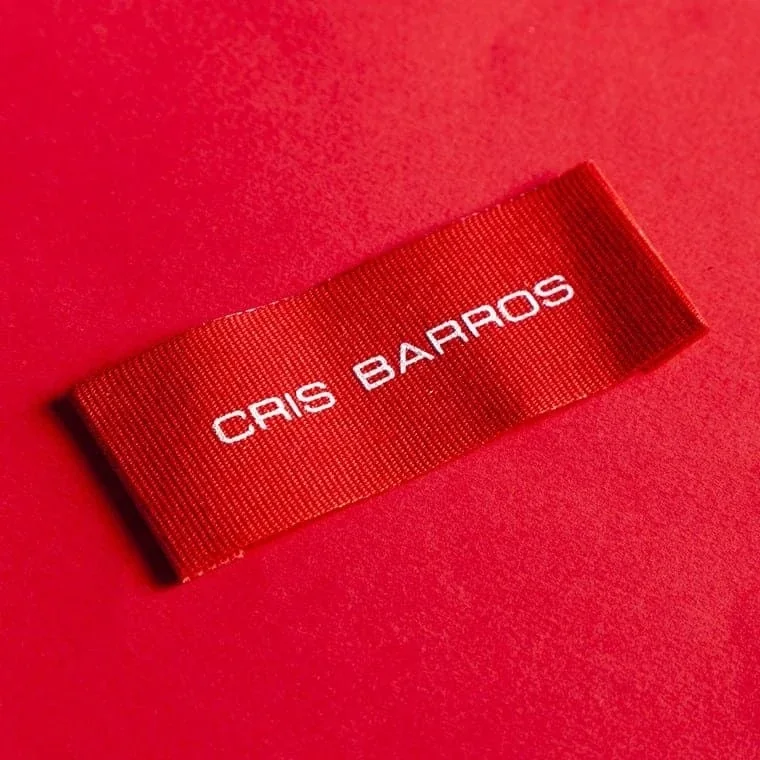
Printed labels: thin, soft and endlessly flexible
Printed labels carry your design on the surface of a ribbon instead of weaving it into the structure. The ribbon itself stays thin and supple, so custom printed labels disappear comfortably inside silk blouses, jersey dresses, shirts and childrenswear, where a thicker woven label would be felt at every movement. Ink also reproduces detail that a loom cannot draw: very small type, hairline rules, gradients, barcodes and even photographic artwork.
For many brands, printed clothing labels do the everyday work while a woven label carries the signature. Sizes, seasons, capsule names, style numbers and anything else that changes from one drop to the next are faster and simpler to print than to weave. Below you will find how the different print processes work, which ribbons they suit, what your artwork needs and how to make a printed label last as long as the garment.
Print methods for custom printed labels
Four processes cover almost every printed textile label. Each has a different setup, ink system and sweet spot, and the right one depends on your design, your ribbon and the number of versions you need.
Flexographic printing
Flexography is a relief process. The artwork is made into a flexible photopolymer plate that is wrapped around a cylinder; an anilox roller with microscopic cells meters a thin, even film of ink onto the raised areas of the plate, which then kisses the moving ribbon. Several print stations in a row allow several colours in one pass, each with its own plate and drying unit. Presses built for textile tapes usually run more slowly than paper label presses, with equipment for garment labels commonly specified in a range of roughly 10 to 60 metres per minute. Flexo is ideal for repeated logos and long, continuous runs on rolls, because once the plates are mounted every metre is identical.
Screen printing
In screen printing, ink is pushed through a fine mesh stencil with a squeegee. The ink layer is much thicker than in flexo, which gives strong opacity: white or metallic ink on a black ribbon stays bright, and the print has a slightly raised, tactile feel. Flatbed screens print label by label or in short sections, while rotary screens use a seamless cylindrical mesh for continuous tape. Screen printing is the preferred method for light-on-dark designs, logo tapes and bold one- or two-colour artwork.
Thermal transfer printing
A thermal transfer printer uses a print head with a row of tiny heating elements that melt ink from a ribbon (a coated film) onto the textile tape. Because the image is generated electronically, every label can be different with no plate or screen. Typical textile printers use 300 dpi heads and print at around 100 mm per second; resin ribbons designed for fabric are chosen when the print must withstand washing, ironing and dry cleaning. Thermal transfer is the process behind most care, composition and size labels, and the natural choice whenever a run contains many sizes, codes or languages.
Digital inkjet printing
Digital printing jets droplets of ink directly onto the ribbon from a print head, so full-colour images, gradients and photographs become possible without separations. Industrial label inkjet presses typically work at native resolutions of 600 to 1,200 dpi. On textiles, the ink chemistry and pre-treatment of the ribbon matter as much as the resolution, so digital printing is used selectively for decorative labels and special editions rather than for every inside label.
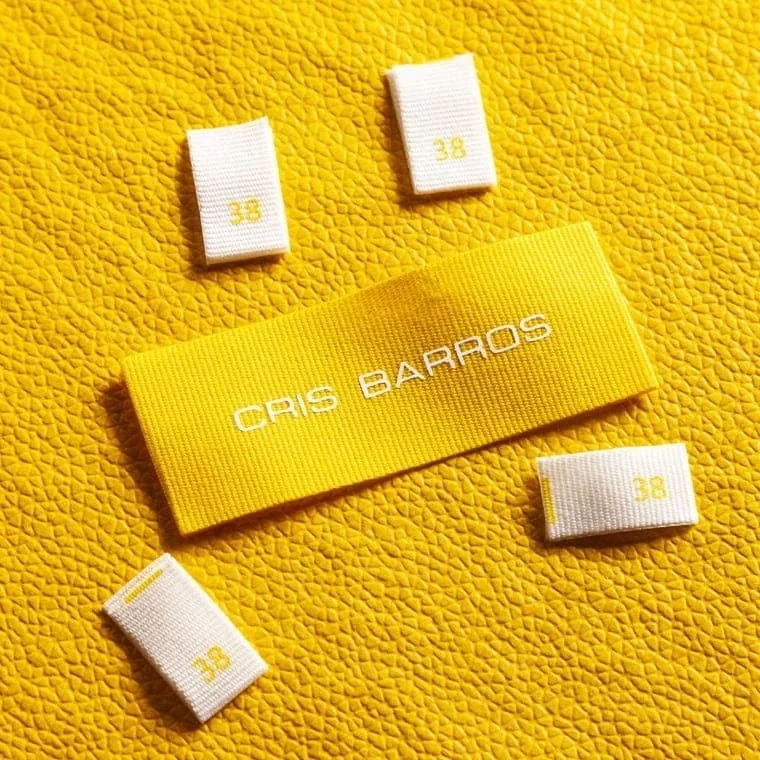
Comparing the four processes
| Process | Setup | Strength | Limits | Best for |
|---|---|---|---|---|
| Flexographic | Plate per colour | Fast, consistent on long rolls | Thin ink film, light on dark is weaker | Repeated logos, logo tapes, main labels |
| Screen | Screen per colour | Rich, opaque ink, tactile feel | Very fine detail is harder | White or metallic on dark ribbon |
| Thermal transfer | None, purely digital | Every label can differ | Usually one colour per pass | Care, size, composition, codes |
| Digital inkjet | None, purely digital | Full colour and photos | Ink and ground must be matched carefully | Decorative and limited editions |
Choosing the ribbon for printed clothing labels
The ground fabric controls three things: how the label feels against the body, how sharply ink sits on the surface, and how the print behaves after many washes.
- Satin (polyester, sometimes acetate) has a smooth, slightly glossy face and soft edges. It is the classic ground for fashion labels in dresses, blouses, lingerie and eveningwear. Double-faced satin looks the same on both sides, which matters for centre-folded labels.
- Nylon taffeta is very thin, dense and smooth, usually coated to accept thermal transfer ink. It holds the smallest text of any common ground and is a workhorse for care and composition labels.
- Polyester tape is stable, strong and very wash-resistant. It suits sportswear, workwear and garments that go through hot washes and tumble drying.
- Cotton tape has a matte, natural look and a soft hand. It fits organic lines, babywear and home textiles, though very fine detail is a little less crisp on its open surface.
- Grosgrain has a ribbed surface with a tailored look, used for logo tapes, hanger loops and accessories; bold artwork works best because the ribs break up very thin lines.
Most grounds come in widths from narrow tabs to wide tapes, and in white, ecru, black and a range of dyed colours. For more on yarns and finishes, see our materials overview.
Step-by-step production of printed labels
- Artwork check. Your file is checked for size, line weight, text height, colour count and bleed. Fonts are outlined and colours assigned to the chosen ink system.
- Digital proof. You receive a proof at true size with the ground colour, ink colours, fold and cut lines marked. Nothing is printed until you approve it.
- Plate, screen or file preparation. Flexo plates are exposed and mounted, screens are coated and exposed, or for thermal transfer and digital printing the print file is simply loaded with its variable data.
- Printing. The ribbon runs from a reel through the press under controlled tension. Tension matters: too much and the ribbon stretches, distorting the print; too little and it wanders, shifting the image sideways.
- Curing or drying. Water-based and solvent inks are dried with heat, UV inks are cured with ultraviolet light, and thermal transfer prints are fixed by the print head itself. Proper curing is what gives wash resistance.
- Cutting and folding. The printed tape is cut to length with a hot knife or ultrasonic blade that seals the edge, then folded flat, centre, end or as a loop, or left on rolls for automatic application.
- Quality control and packing. Labels are checked for registration, colour, legibility, correct variable data per style and clean cuts, then bundled and labelled per style and size.
From the moment you approve the proof, production and delivery take 10 days. More detail on our workflow is on the production page.
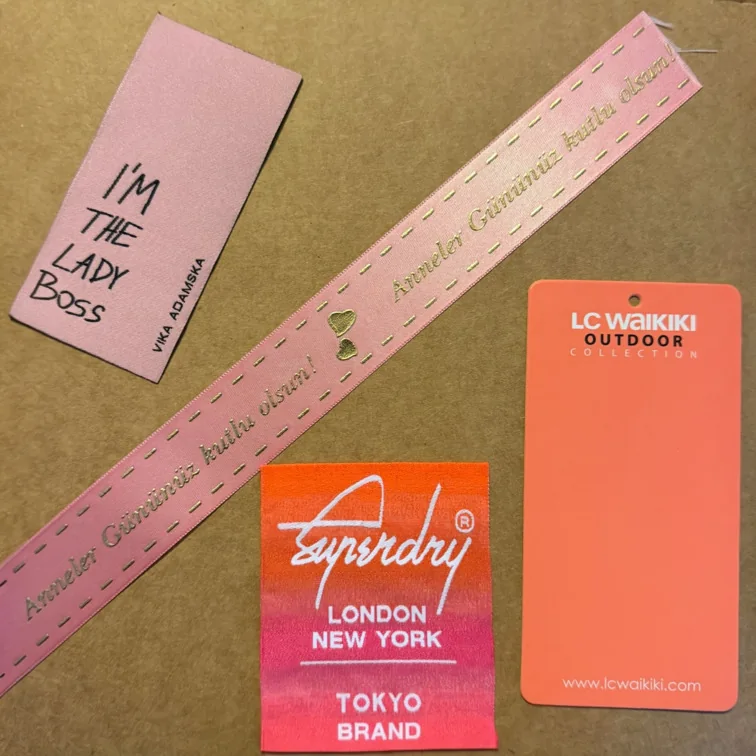
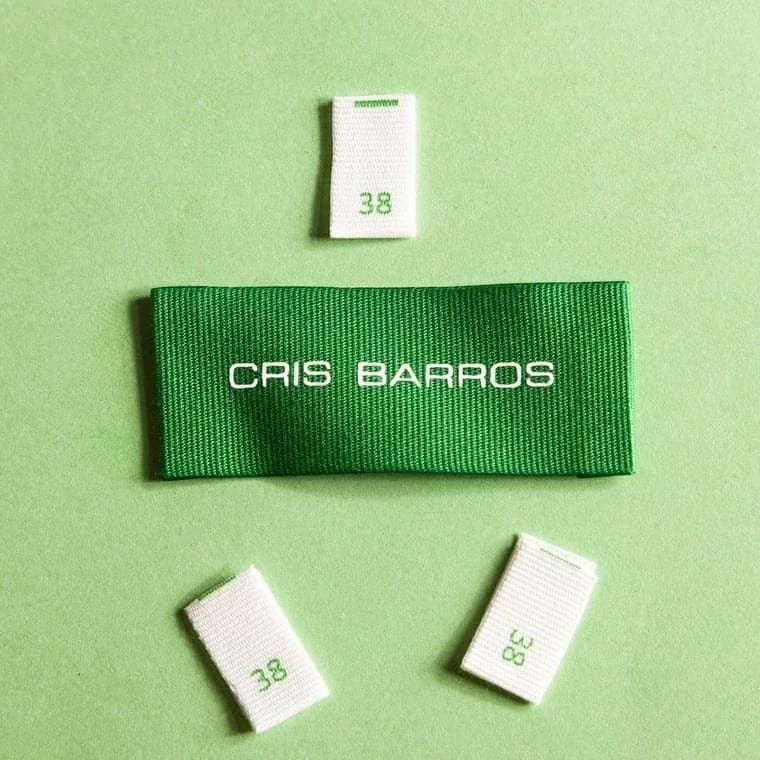
Artwork requirements for printed labels
Printing is far less restrictive than weaving, but textile grounds still impose limits that paper does not.
Text and lines
On nylon taffeta and coated satin, clean sans-serif text remains readable at small sizes, often down to around 1.5 mm in capital height with thermal transfer. On cotton or grosgrain the surface texture absorbs detail, so text and lines should be noticeably heavier. As a rule of thumb, keep line weights above roughly 0.2 mm and avoid hairline reversed (white-out) text in flexo, where ink can spread and fill small counters.
Colours
Spot colours are matched by mixing ink to a reference; tell us the colour codes from your brand guide. Remember that the same ink looks different on white satin, ecru cotton and black tape, because the ground shows through to some degree. For light ink on dark ribbon, screen printing or a double hit of ink gives the necessary opacity.
Variable data
If one design needs many versions, such as sizes, style codes or batch numbers, send a simple spreadsheet listing each version and its quantity. Thermal transfer and digital printing handle this in a single run, and the labels are sorted per version when packed.
Files to send
- Vector artwork (PDF, AI, EPS or SVG), text outlined, at final size.
- Colour references and the ribbon colour you prefer.
- Finished label size, fold type and whether you want rolls or cut pieces.
- A list of variable texts, if any.
Making printed labels last
A printed label fails when the ink loses its grip on the ground, not when the ribbon wears out. Wash durability is the result of four choices made together:
- Ink and ribbon pairing. Resin-based thermal transfer ribbons on coated nylon or polyester give the most wash-resistant result for text and symbols.
- Curing. Inks that are under-dried may look perfect when delivered but fade after a few washes; correct temperature and dwell time are part of quality control.
- Ground. Polyester and nylon tapes hold ink better than open cotton when garments are washed hot or tumble dried often.
- Use. Abrasion inside the garment, harsh detergents and high ironing temperatures all wear prints faster; pick the pairing for the hardest treatment the garment will see.
Common printing defects and how to avoid them
| Defect | Cause | Prevention |
|---|---|---|
| Blurred or filled-in text | Text too small for the ground, ink spread | Heavier type, smoother ground, thermal transfer |
| Colour shifts between batches | Different ribbon dye lot or ink mix | Recorded ink recipes, checks against the approved proof |
| Misregistration | Ribbon stretch or wander | Controlled tension, stable grounds |
| Fading after washing | Wrong ink or poor curing | Resin ribbons, correct curing, suitable ground |
| Frayed ends | Cold cutting on synthetic ribbon | Hot-knife or ultrasonic cutting |
Ideas for using printed labels
Printed labels go well beyond the neck. Logo tape repeated along its length can become hanger loops, placket tapes and drawstring channels. Small printed flags can sit in a side seam. Printed size labels and care labels can be produced in the same run as the main label so the whole set shares one typeface and one colour palette. Because changing artwork only means a new plate or a new file, printed labels suit brands that refresh details with every collection.
Checklist for a printed label order
- Ground: satin, nylon taffeta, polyester tape, cotton or grosgrain.
- Ribbon colour and ink colours.
- Width, finished length and fold.
- Print method preference, or let us recommend one.
- Variable data list, if versions differ.
- Care conditions of the garment.
FAQ about printed labels
01Should I choose a printed or a woven label?
Choose printed when softness, very small text, gradients or frequent changes matter. Choose woven when you want maximum durability and a textured, premium signature. Many brands combine a woven main label with printed care and size labels.
02Will printed labels fade in the wash?
Not when the ink and ground are matched to the care conditions. Resin thermal transfer on coated nylon or polyester tape stays legible through repeated washing. Tell us the washing temperature and whether the garment is tumble dried, and we recommend the right pairing.
03Which print method gives the best white on a black ribbon?
Screen printing, because it lays down a thicker, more opaque ink layer. Flexo can also print white, but the thinner ink film lets more of the dark ground show through.
04Can each label carry different information?
Yes. Thermal transfer and digital printing create every label from a file, so sizes, codes, batch numbers or languages can change label by label within one run.
05What is the softest ground for printed labels?
Satin and cotton tape are the softest. Satin is smooth with a gentle sheen, cotton is matte and natural. Both can be cut with sealed edges and folded to sit comfortably in a seam.
06How long does it take to receive printed labels?
After your price request we send a digital artwork proof. From your approval, production and delivery take 10 days.
07Are there sustainable ribbons?
Yes. OEKO-TEX and GRS options are available for selected materials, including recycled polyester and cotton grounds.
Have a design ready? Request a price for your printed labels and we will reply with a digital proof and a recommendation for ground and print method.