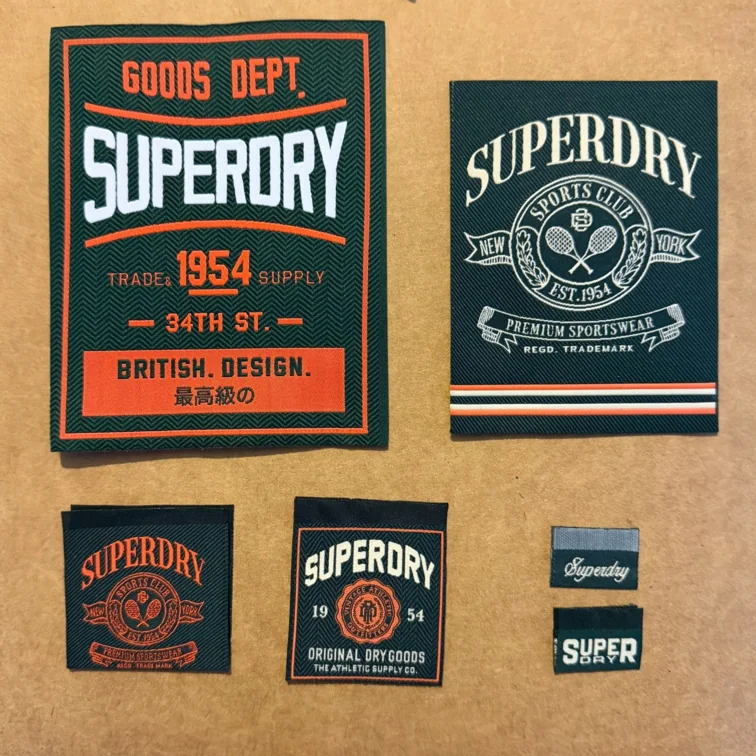
Textile labels: the fabric side of your brand
Textile labels are labels made of cloth: woven, printed or transferred onto a ribbon or fabric ground, then cut, folded and sewn or pressed into a product. They are the most widespread way of identifying a garment, a bag or a towel, because they move with the material, survive washing and feel like part of the item rather than something attached to it. Brand labels, care and composition labels, size tabs, logo tapes, hanger loops and outside badges all belong to the same family of textile labels for clothing and home products.
This page is an overview of that family. It explains how the main construction methods differ, how to choose a ground fabric and a finish for each type of product, and how a textile label is produced from your artwork to a packed bundle. For each specific type you will find a deeper page linked along the way.
Three ways to make a textile label
Woven
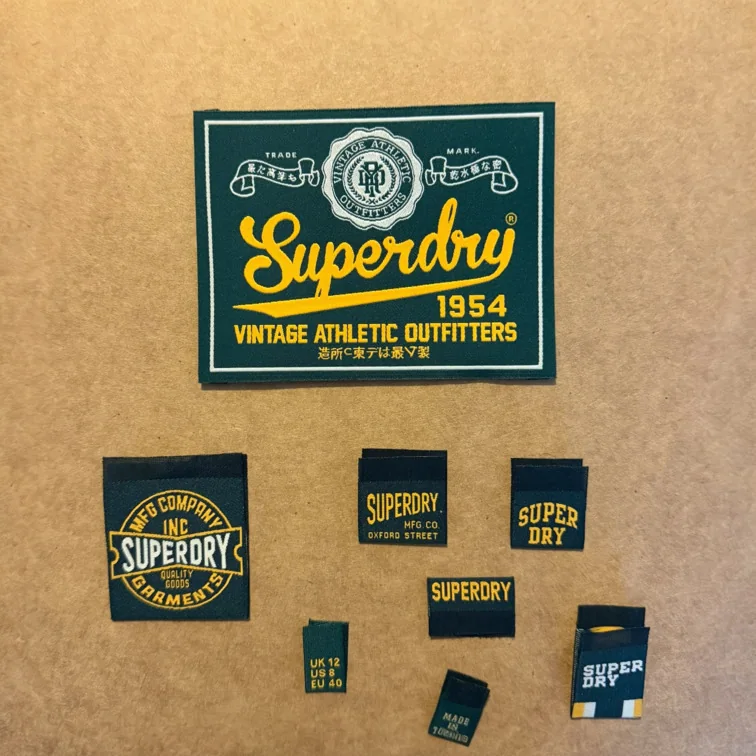
In a woven label the design is created by the yarns themselves. Weft threads of different colours are lifted and lowered by a jacquard mechanism so that the logo appears in the structure of the cloth. Woven labels are thicker and more textured, very durable, and give a premium, tactile signature. They are the usual choice for the main brand label and for badges on the outside of a garment.
Printed
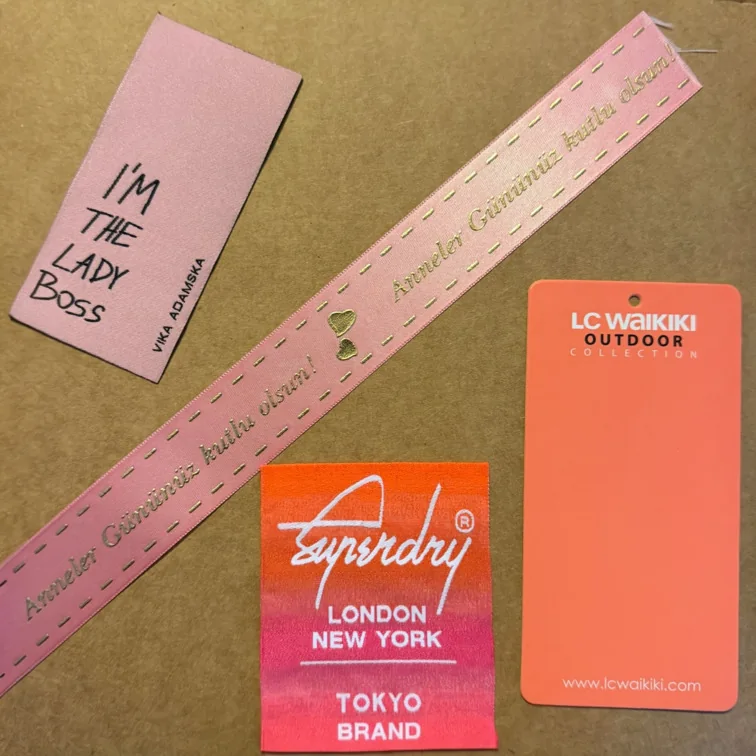
In a printed label the design is applied to the surface of a finished ribbon by flexographic, screen, thermal transfer or digital printing. Printed labels are thinner and softer and can carry very small text, many versions in one run and colour effects a loom cannot weave. They dominate care, composition and size information and are popular for soft brand labels in lightweight garments.
Heat transfer
A heat transfer is a printed image on a carrier that is pressed directly onto the garment with heat and pressure, leaving no separate tape at all. Strictly speaking it is not a sewn textile label, but it often replaces one in sportswear, T-shirts and underwear, where a tag-free neck is preferred.
| Method | Thickness | Detail | Durability | Typical role |
|---|---|---|---|---|
| Woven | Medium to thick | Fine, but limited by yarn | Very high | Main labels, badges, logo tapes |
| Printed | Thin | Very fine, many colours | High with suitable ink | Care, size, soft main labels |
| Heat transfer | None (on fabric) | Very fine | Depends on fabric and wash | Tag-free necks, sportswear |
Ground fabrics for textile labels
The ground is the base fabric of the label. In woven labels it is formed by the warp and the background weft; in printed labels it is the ribbon you print on. Its fibre and construction decide comfort, appearance and wash behaviour.
Polyester
Polyester is the backbone of label production. It is strong, colourfast, dimensionally stable and melts cleanly at the cut, so heat and ultrasonic cutting produce a sealed edge. Almost all damask woven labels and most printed tapes are polyester. Recycled polyester qualities are available for many grounds.
Satin
Satin describes a construction with long floats on the face, usually in polyester. It is smooth, slightly lustrous and very gentle on the skin, which makes it a favourite for dresses, lingerie, blouses and knitwear.
Nylon taffeta
A thin, dense, smooth ribbon, typically coated to accept print. It holds the smallest type of all common grounds and is widely used for care and composition labels with several languages.
Cotton
Cotton tape and cotton canvas have a matte, natural character and a soft hand. They suit organic and natural ranges, babywear and home textiles. Cotton does not melt, so edges are folded or woven rather than heat-sealed.
Grosgrain
Grosgrain has pronounced ribs across its width, which give a tailored look. It is used for logo tapes, hanger loops, accessories and gift packaging. Bold artwork reads best on its textured surface.
Non-woven
Non-woven grounds are made of bonded fibres rather than interlaced yarns. They feel paper-like and soft and suit items that are rarely washed, such as accessories, bags or decorative textiles.
Matching textile labels to the product
A good textile label behaves like the product it sits in. A stiff, heavy label in a fine knit pulls the fabric and scratches; a delicate label in a work jacket wears out before the jacket does. The table below is a starting point for typical product groups.
| Product | Suggested label | Why |
|---|---|---|
| Knitwear and jersey | Satin woven or soft printed satin, ultrasonic edge | Soft, flexible, does not distort the knit |
| Shirts and blouses | Thin damask or printed satin, end fold | Flat at the collar, invisible from outside |
| Denim and outerwear | Damask woven, flat or loop fold; leather patch | Robust, matches heavy fabrics |
| Lingerie and swimwear | Printed satin or heat transfer | Minimal thickness, comfortable on skin |
| Babywear | Cotton or soft satin, sealed soft edges | Gentle on sensitive skin |
| Bags and backpacks | Damask woven, flat or folded into a seam | Withstands abrasion and handling |
| Towels and bedding | Polyester woven or printed tape, mitre or loop fold | Tolerates frequent hot washing |
For products where fabric labels are not the right answer, such as jeans patches or swimwear accents, leather labels and silicone labels are worth considering.
From artwork to finished textile labels
Whether woven or printed, every textile label follows a similar sequence. The details differ by method, but the logic is the same.
- Brief. You describe the label: size, method, ground, colours, fold, attachment and the products it goes into.
- Artwork preparation. Your logo is converted for weaving (each colour becomes a yarn and each area a binding) or prepared for printing (colours separated, fonts outlined, variable data organised).
- Digital proof. You receive a true-to-size proof showing layout, colours and fold. Production starts only after your approval.
- Production. Labels are woven on jacquard looms or printed on the chosen ribbon. Woven cloth is heat-set to stabilise it; printed tapes are dried or cured so the ink bonds to the fibres.
- Cutting. Synthetic labels are cut with heat, ultrasound or laser so the edge fuses; cotton is folded or finished with a woven edge.
- Folding and backing. Labels are folded to suit the seam they will sit in, and given an iron-on or soft backing if requested.
- Quality control. Size, colour, text, fold and edge are checked against the approved proof; versions are sorted.
- Packing and delivery. Labels are bundled per design and version. Production and delivery take 10 days from artwork approval.
More about how we organise this is on our production page.
Edges, folds and attachment
Edges
- Heat cut: a heated blade seals synthetic edges quickly and firmly.
- Ultrasonic cut: vibration energy melts the fibres into a smoother, softer seal.
- Laser cut: precise, allowing shaped outlines.
- Woven selvedge: produced on narrow looms; the long edges are never cut and stay the softest.
Folds
Flat labels are stitched around their edges or at both ends. Centre-folded labels hang from a seam and show both faces. End folds tuck both ends under for a clean back-neck finish. Mitre and loop folds create a hanger loop. Booklets stack several panels for long care and composition content.
Attachment
Most textile labels are sewn, either into a seam or topstitched onto the fabric. Iron-on backings let labels be pressed on with heat, useful for accessories and short runs. Labels can also be hung with loops or fixed with label fasteners; all metal parts we supply are nickel-free.
Washing, shrinkage and comfort
A textile label goes through every wash the product does, so it should be specified for the toughest treatment the product will see.
- Shrinkage. Polyester labels hardly shrink, while cotton garments may. If a cotton garment shrinks around a stable label, the seam can pucker; a softer, more flexible label or a seam position with some ease avoids this.
- Colourfastness. Dark labels in light garments should be made from colourfast dyed yarns or tapes so that colour does not migrate in the first wash.
- Heat. Home textiles such as towels and bedding are washed hotter and more often than clothing. Polyester grounds and wash-resistant inks keep their legibility longest.
- Comfort. Edges are the most common source of irritation. Sealed ultrasonic edges, woven selvedges and soft coatings make the difference in garments worn next to the skin.
Common mistakes with textile labels
- Specifying size without the fold. A 50 mm label folded at both ends shows less than 50 mm. Give the visible size and the fold so we calculate the cut length.
- Too much information on one label. Splitting brand, size and care across separate labels often looks cleaner and feels better than one crowded tape.
- Ignoring the seam. A label caught in an overlocked side seam needs a margin free of text.
- Using the same label everywhere. A label that is perfect for a coat may be too heavy for a silk camisole. Two or three label variants across a collection are normal.
Checklist for a textile label request
- Products the labels are for, and how they are washed.
- Method: woven, printed or heat transfer.
- Ground fabric and colour.
- Visible size, fold and edge type.
- Attachment: sewn, iron-on or loop.
- Artwork, colour references and any variable data.
FAQ about textile labels
01What is the difference between textile labels and woven labels?
Textile labels is the umbrella term for all fabric labels. Woven labels are one type within it, where the design is formed by the yarns. Printed fabric labels and heat transfers are the other main types.
02Which fabric is softest for a clothing label?
Satin and cotton are the softest grounds. Combined with an ultrasonic edge or a woven selvedge, they are comfortable even in knitwear and babywear.
03Are textile labels suitable for towels and bedding?
Yes. Polyester woven or printed labels tolerate frequent hot washing. A mitre or loop fold, sewn into the hem with a generous margin, keeps them secure.
04Can textile labels be ironed on?
Yes, with an iron-on backing. For products washed often, adding a few stitches gives long-term security.
05Do you offer sustainable textile labels?
OEKO-TEX and GRS options are available for selected materials, including recycled polyester and cotton grounds, listed on our materials page.
06How does ordering work?
You send a price request with your artwork and details. We prepare a digital artwork proof, and after your approval, production and delivery take 10 days.
Planning labels for a new collection? Request a price for your textile labels and we will suggest the right method, ground and finish for each product.