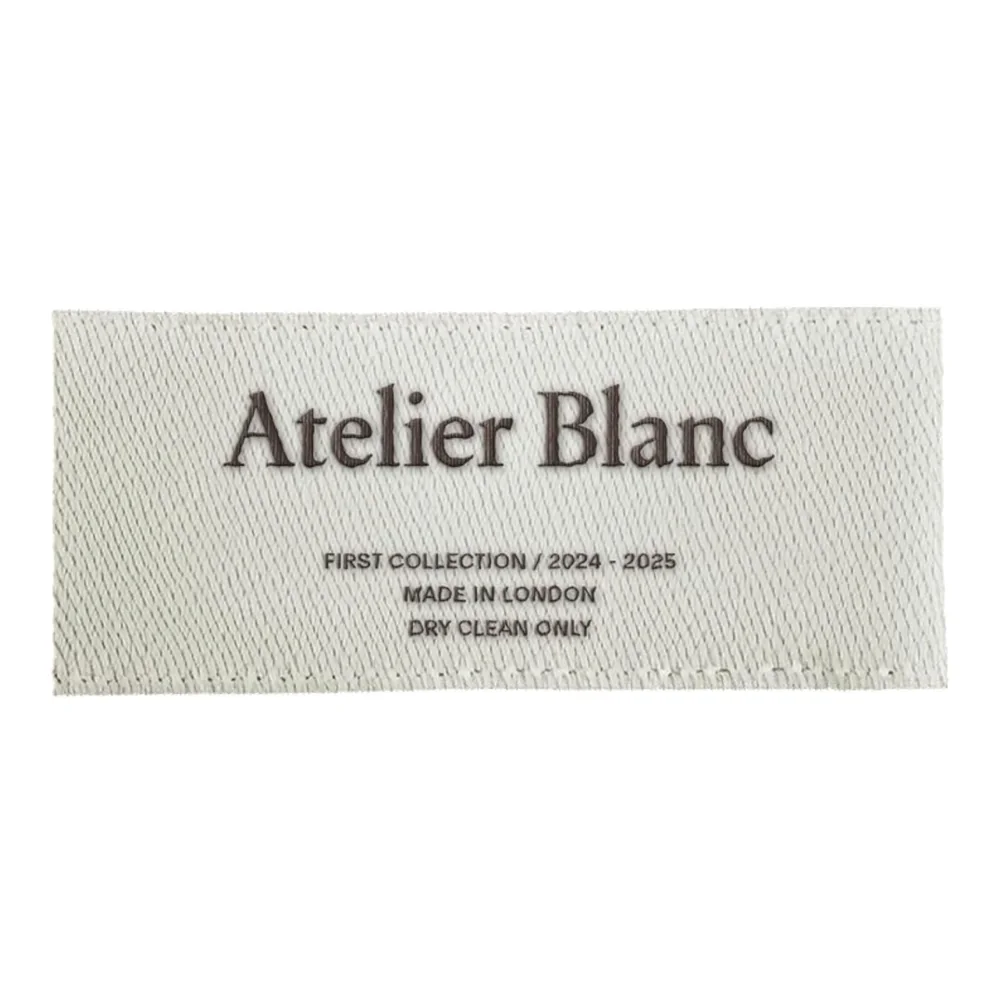
Woven labels: your logo built into the cloth
Woven labels are the most permanent way to put a brand name inside a garment. Instead of ink sitting on a ribbon, the lettering, logo and background are all formed by yarns crossing each other on a loom, so the design cannot rub off, crack or fade the way a surface print can. That is why custom woven labels remain the default neck label for ready-to-wear, denim, knitwear, outerwear and accessories, and why so many young brands make a woven label their very first branding purchase.
This page explains how woven clothing labels with a logo are actually produced, what the different weaves can and cannot reproduce, how to prepare artwork that weaves cleanly, and which edge, fold and backing options suit which garment. If you already know what you need, you can go straight to a price request; we reply with a digital artwork proof, and once you approve it, production and delivery take 10 days.
How woven labels are made, step by step
Every woven label passes through the same chain of operations. Knowing them helps you understand why some details are possible and others are not, and why a small change to artwork can make a big difference to the finished piece.
1. Artwork conversion and weave programming
Your logo arrives as a vector or image file. A weave designer redraws it on a grid where each cell represents one crossing point of warp and weft. Each colour in the design is assigned to a weft yarn, and each area is given a binding structure: how often the weft floats over the warp before it is tied down. Long floats look glossy and smooth but can snag; short floats are tighter and more durable. This “point paper” file is what the loom reads, and it is the step where thin lines are checked against the minimum the yarn can draw.
2. Warping and loom setup
The warp is the set of lengthwise threads that runs through the whole loom. Label weavers usually keep a fine warp in a neutral colour such as black, white or ecru mounted on the machine, and change only the weft yarns from order to order. That is why the background colour of a damask label is often achieved with weft, not warp, and why matching an exact background shade sometimes means choosing the nearest standard warp and adjusting the weft above it.
3. Weaving on a jacquard loom
Modern label production relies on electronic jacquard heads. Each warp thread is lifted by its own hook, controlled individually by the pattern file, so the loom can draw any shape rather than repeating a fixed pattern. Broad label looms are commonly fitted with jacquard heads of around 1,500 to 3,000 hooks, enough to weave many labels side by side across the width of the cloth. The result comes off the loom as a wide sheet of labels in rows, or as narrow strips if the labels are woven on a ribbon loom.
4. Finishing the woven sheet
The woven cloth is often passed through a calendering or heat-setting step. Heat and pressure flatten the surface, stabilise the polyester so the label will not curl, and give the face its final smoothness. A soft finish or coating can be added at this stage for labels that sit against bare skin.
5. Cutting and folding
Labels woven as a sheet are slit into strips and then cut to length. The cut edge is sealed by heat, ultrasound or laser so the polyester fuses rather than frays. Automatic cut-and-fold machines then fold each piece and stack it. Industry figures for these machines vary widely with label size and fold type, from a few dozen to a few hundred labels per minute, which is why folding is planned together with the weaving schedule rather than as an afterthought.
6. Inspection and packing
Finished labels are checked against the approved proof for colour, lettering, size and fold position. Typical faults that inspectors look for are broken or missing picks (thin horizontal stripes), floats that pull loose, colour bleeding from one yarn area into another, and folds that sit off-centre. Approved labels are counted, bundled per style and packed so they arrive ready for the sewing line.
Machines behind custom woven labels
Two families of looms dominate label weaving, and each one shapes the product in a different way.
Broadloom label looms (rapier and air-jet)
Broad label looms weave a fabric roughly a metre or more wide and carry many labels across that width at once. On rapier machines, a gripper carries each weft pick across the shed; on air-jet machines, a jet of compressed air does the same job. Published industry research describes rapier label looms running in the region of 680 to more than 800 picks per minute, and recent air-jet label machines are advertised at around 950 revolutions per minute, with adjustable weft density roughly between 18 and 120 picks per centimetre and weft yarns from about 30 to 250 dtex. These machines can switch between several weft colours pick by pick, which is how a multi-colour damask is woven. Many are fitted with rows of heated cutting elements that slit the labels into strips while the cloth is still on the loom.
Needle looms (narrow fabric)
Needle looms are narrow-fabric machines. Instead of a shuttle or gripper, a needle carries the weft in and out from one side, and a latch needle on the opposite side locks it, creating a true woven selvedge on both edges. They run considerably faster than broadlooms on narrow tapes, with high-speed models reaching a few thousand picks per minute. A narrow jacquard head allows logos and lettering on the tape. Needle-loom labels are the ones with the softest possible edge, because nothing is cut along the length.
Which loom suits which label
| Feature | Broadloom (rapier or air-jet) | Needle loom |
|---|---|---|
| Typical output | Sheets of labels side by side | A single tape or a few tapes |
| Long edges | Cut and sealed (heat, ultrasonic, laser) | Woven selvedge, no cut |
| Detail and colours | Very fine detail, many weft colours | Simpler designs, fewer colours |
| Best for | Neck labels, logo badges, patches | Logo tapes, hanger loops, soft edge labels |
Damask, satin, taffeta: choosing the weave for woven labels
The name of a weave describes the binding and the yarn, and together they decide how sharp the lettering can be and how the label feels.
- Damask woven labels use a fine polyester yarn, typically around 100 denier, packed tightly. They are the standard choice for clothing brands: crisp, smooth and durable, with a slightly matte face.
- High-definition (HD) damask uses an even finer yarn, often around 50 denier, so more picks fit into each centimetre. Fine serif typefaces, small icons and thin outlines survive much better.
- Satin woven labels have long floats on the face, giving sheen and a smooth hand. Detail is softer than damask, but comfort and elegance are higher.
- Taffeta woven labels use a simple, open binding. They are lighter, flatter and more economical, suited to bold logos and inside labels with simple content.
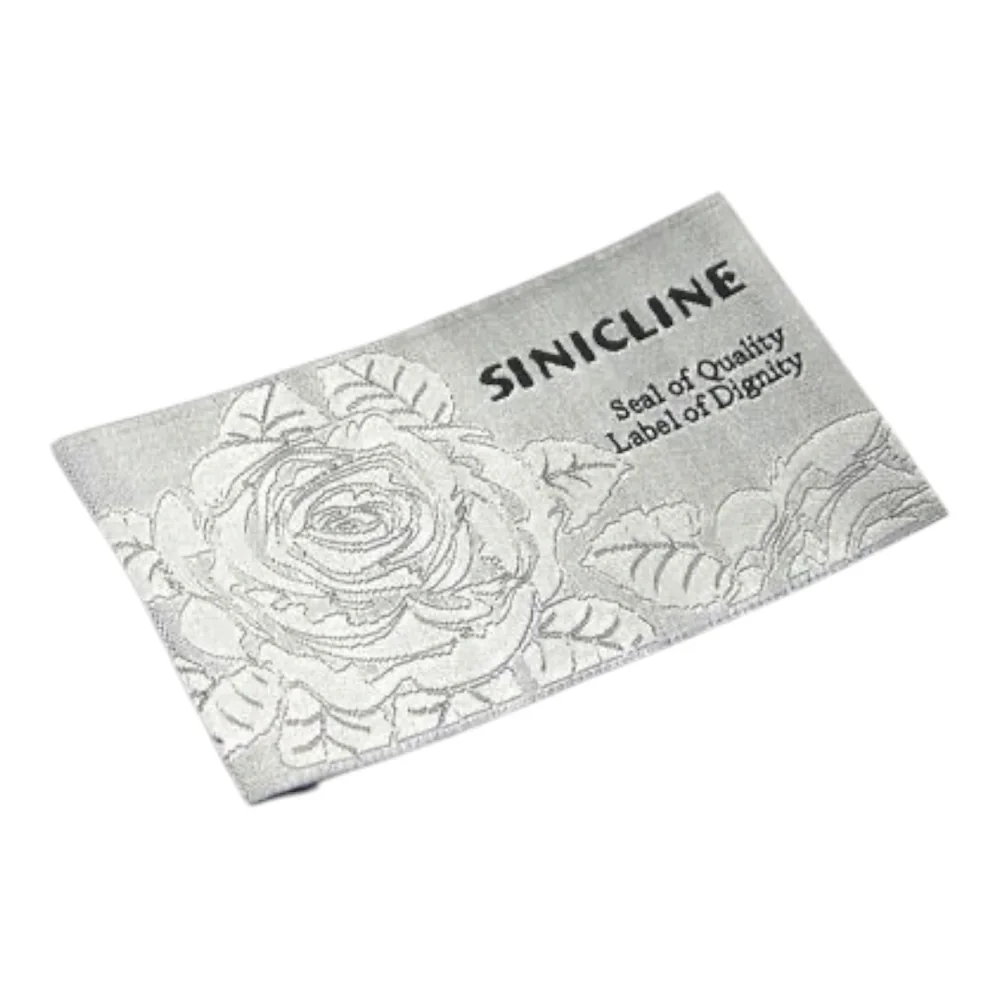
- Jacquard and textured weaves play with patterned grounds, ribs and raised effects for statement labels and decorative patches.
| Weave | Detail | Hand | Look | Typical use |
|---|---|---|---|---|
| Damask | High | Smooth, firm | Matte | Main neck labels, denim, outerwear |
| HD damask | Very high | Thin, smooth | Matte, refined | Small serif logos, premium ranges |
| Satin | Medium | Very soft | Glossy | Lingerie, eveningwear, silk blouses |
| Taffeta | Low to medium | Light, crisp | Flat | Bold logos, workwear, simple text |
| Jacquard texture | Varies | Structured | Patterned | Badges, patches, logo tapes |
Design limits and artwork requirements
Weaving draws with thread, so every line has a physical minimum. Keeping your design inside these limits is the single best way to get a label that matches your expectations.
Text and line thickness
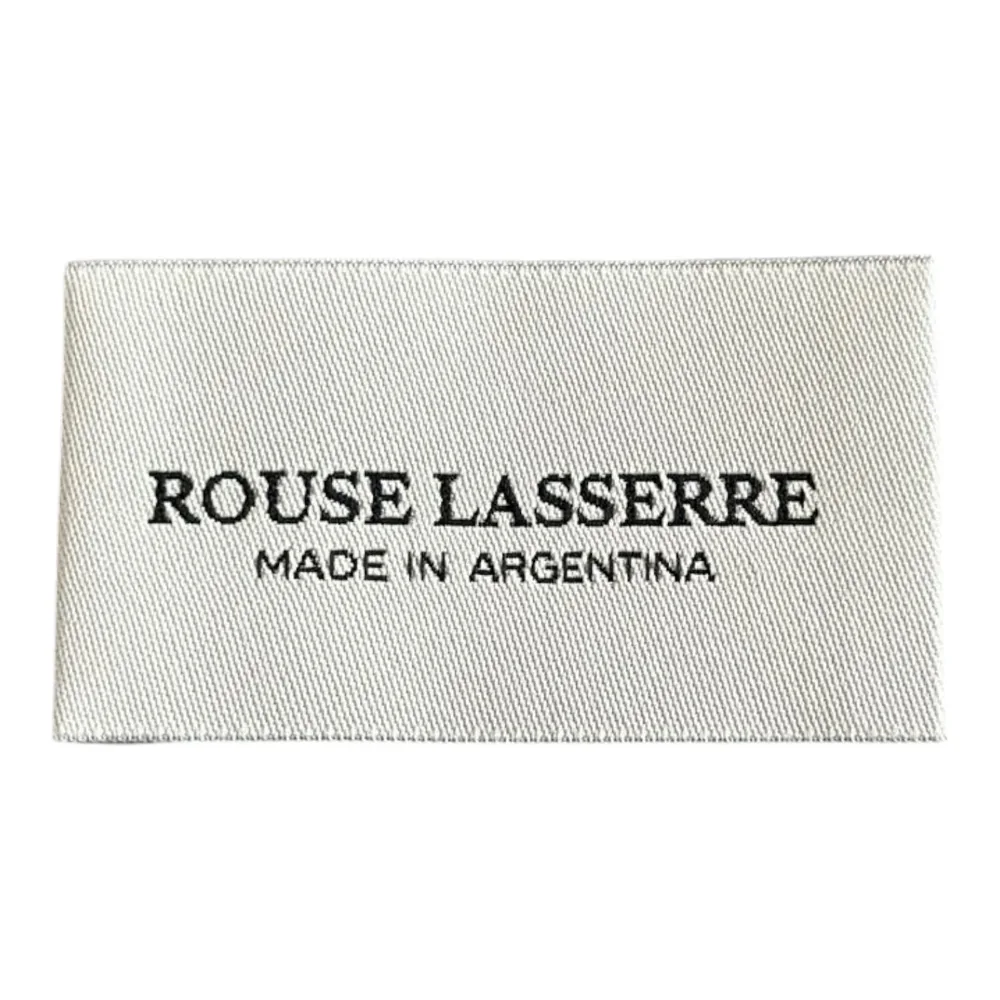
On a standard damask, lettering remains comfortably legible down to roughly 2 mm in capital height; below that, letters start to close up. Hairlines thinner than about the width of two warp threads may disappear, so very thin serifs are usually thickened slightly during weave programming. HD damask relaxes these limits, which is why it is recommended for serif wordmarks under about 8 mm tall.
Number of colours
Each colour in the design needs its own weft yarn, plus the warp colour that shows through the background. Most labels use between two and eight colours. Every extra colour adds yarn layers to the back of the label, which makes it slightly thicker and stiffer, so very colourful designs are better placed on outside badges than on neck labels.
Gradients, photos and fine shading
A loom cannot mix colours the way ink does. Gradients are simulated by alternating two yarns in different ratios, which reads as a coarse transition rather than a smooth fade. Photographic images are not suitable for weaving; a printed label or heat transfer handles them far better.
Files to send
- A vector file (AI, EPS, PDF or SVG) with text converted to outlines is ideal.
- If you only have a JPG or PNG, a clear, high-resolution image is enough; our studio redraws it.
- Indicate the finished size, the fold type and the colour references you want to match.
- Mark which areas are background and which are lettering if the design is ambiguous.
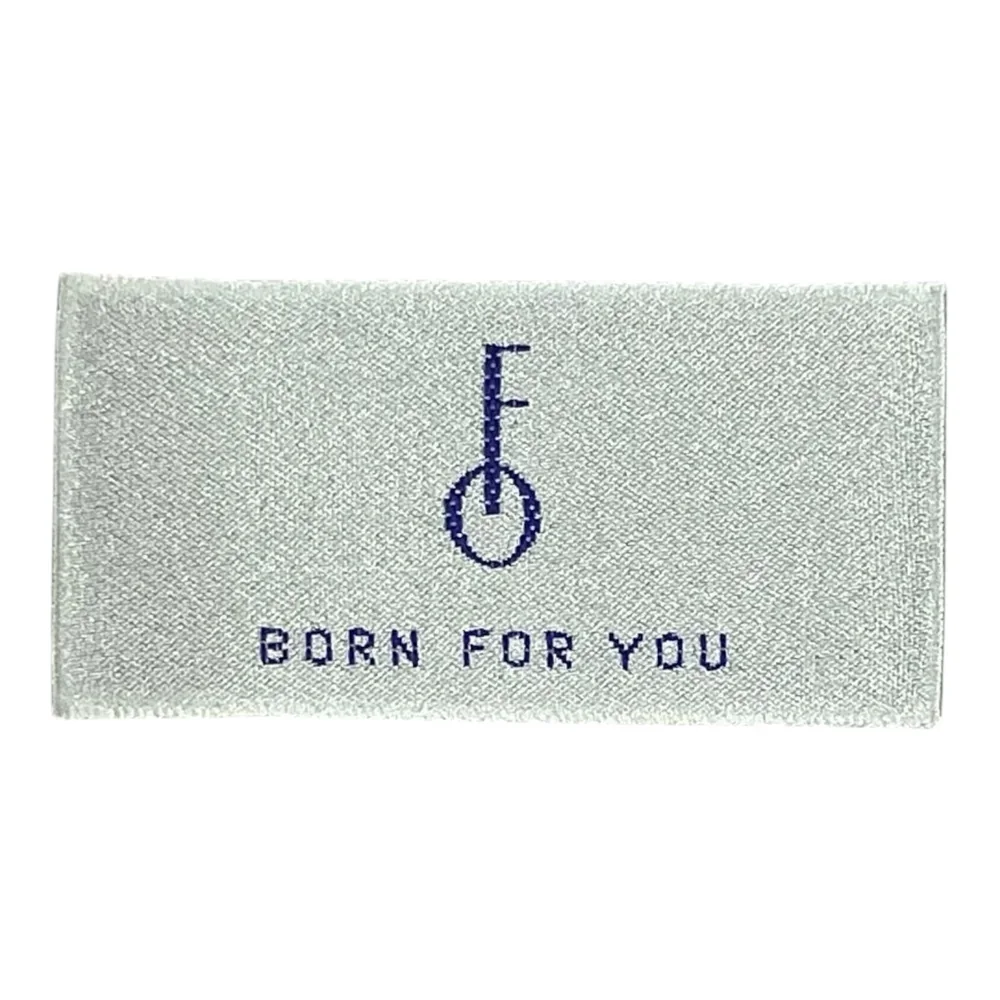
Edges, folds and backings for woven clothing labels
Edge types
- Laser cut: very precise, allows shaped outlines such as circles or shields, with a firm sealed edge.
- Ultrasonic cut: high-frequency vibration melts and seals the polyester, giving a softer edge than hot-knife cutting; a good default for neck labels.
- Hot-knife cut: a heated blade fuses the cut ends; robust and fast, slightly firmer to the touch.
- Woven selvedge: the long edges are woven, not cut, so they are the softest; only the ends are cut.
Folds
The fold decides how the label is sewn and how much of it shows.
- Flat (straight cut): stitched on all four sides or on two ends; common on denim and bags.
- Centre fold: folded in half and caught in a seam; front and back can carry different information.
- End fold: both ends tucked under, sewn along the ends; neat at the back neck.
- Mitre fold: angled folds create a hanging loop, typical for coats and towels.
- Loop fold: folded so both ends are sewn together into a seam, leaving a loop.
- Booklet fold: several panels folded together for longer content.
Backings and coatings
An iron-on or heat-seal backing lets the label be pressed in place without sewing, which is useful for accessories, caps and quick personalisation. A soft coating on the back stops stiff yarn ends from scratching, especially on knitwear and babywear. On request, labels can also be supplied flat on a roll for automatic dispensing.
Washing, wear and common defects
Polyester damask labels tolerate the domestic washing temperatures used for most garments and keep their lettering for the life of the piece. Problems usually come from mismatched choices rather than from the weave itself:
- Curling after washing appears when a label is too long for its width or was not heat-set; correct proportions and finishing prevent it.
- Scratchy edges come from hard cut edges on fine knits; choose ultrasonic cutting, a woven selvedge or a soft coating.
- Puckered seams happen when a thick multi-colour label is sewn into a light fabric; reduce colours or switch to satin.
- Lost detail means the artwork was below the limit of the weave; move to HD damask or simplify.
Planning a full label set
A woven main label rarely travels alone. Most collections pair it with printed care labels, woven or printed size labels and a matching hang tag, so that typography and colour stay consistent from the neck to the price ticket. Planning these together means one approval round and one delivery.
Quick checklist before you request a price
- Finished size in millimetres, measured as the label will appear when sewn.
- Weave: damask, HD damask, satin or taffeta.
- Number of colours and their references.
- Edge type and fold.
- Backing or coating, if any.
- Quantity per design and the garments the labels go into.
FAQ about woven labels
01What is the difference between damask and satin woven labels?
Damask uses a fine yarn in a tight binding, so it reproduces small text and thin lines sharply and has a matte face. Satin uses longer floats that give a glossy, very soft surface, at the cost of some fine detail. Choose damask for small logos and durability, satin for comfort and sheen.
02How small can the text on a woven label be?
On standard damask, capital letters of around 2 mm usually stay readable. Thin serifs and hairlines are thickened slightly if needed. For smaller or more delicate type, a high-definition damask with finer yarn keeps more detail.
03How many colours can a woven label have?
Most woven labels use two to eight colours, including the background. Each colour is a separate weft yarn, so more colours make the label a little thicker. For neck labels we usually recommend keeping the palette compact.
04Which edge is the softest for knitwear and babywear?
A woven selvedge is the softest, because the long edges are not cut at all. Among cut edges, ultrasonic cutting gives a smoother seal than a hot knife. A soft back coating adds further comfort.
05Can I iron a woven label on instead of sewing it?
Yes. Labels can be supplied with an iron-on or heat-seal backing. For garments that are washed often, we still recommend a few stitches at the corners for long-term security.
06How long does production take?
After you send a price request, we prepare a digital artwork proof. Once you approve it, production and delivery take 10 days.
07Are sustainable yarns available?
Yes. OEKO-TEX and GRS options are available for selected materials, including recycled polyester yarn for many damask qualities. See our materials page for an overview.
Ready to turn your logo into a woven label? Send us your artwork and request a price, and we will come back with a digital proof and production plan.